
Artificial intelligence is everywhere right now. That customer service chat just might be a bot pretending to be a person named “Dave.”
As AI continues to evolve at warp speed, one question keeps popping up in boardrooms, breakrooms, and Reddit threads: Will cybersecurity be replaced by AI?
Why the Question Exists in the First Place
AI has become shockingly capable in recent years. We watched it:
- Detect suspicious activity across millions of data points
- Flag anomalies faster than any human analyst
- Summarize complex threat reports
- Analyze malware behavior at hyper speed
- Predict breaches based on patterns and past data
AI tools can scan logs, assess risks, correlate events, raise red flags before a tired human analyst would even take a sip of coffee. That is a huge advantage.
In many ways, AI has become a great cybersecurity assistant. Think Batman and Alfred, except Alfred works 24/7, never sleeps, and can analyze 3.4 billion login attempts in real time.
So, if AI is that powerful, why is it not replacing cybersecurity?
Cybercriminals Use AI Too and They Are Not Slowing Down
Cybercriminals use AI just as aggressively as security teams do. AI helps attackers:
- Write more sophisticated phishing emails
- Generate malware variants faster than before
- Scan for vulnerabilities at scale
- Automate attack chains
- Fake voices, videos, and documents
The situation is not “AI cybersecurity” versus “human cybersecurity.” The best situation is humans working with AI- tools to work efficiently.
AI defends. Humans strategize, guide, and make judgment calls.
Cybersecurity is not just a technical problem. Cybersecurity is a human problem. And people, including your employees, vendors, and customers, are unpredictable in all the ways AI is not.
For example, AI will not fall for an “urgent” email based on fear.
AI Is Smart, but Not Human Smart
AI models learn patterns. Cyber threats evolve constantly. Attackers do not follow patterns. They create new ones.
Here is what AI still struggles with:
- Distinguishing between a careless employee and a malicious insider.
- Detecting brand new attack types.
- Zero-day exploits, new ransomware strains, and creative social engineering tactics can slip by.
- Prioritizing actions based on business context.
- Ethical and legal judgment. AI can collect data, but it does not know whether it should collect it.
Cybersecurity often requires innovation. AI imitates patterns. It does not innovate.
Humans bring intuition, creativity, ethical reasoning, and strategic thinking to the table. AI brings raw calculated power.
Cybersecurity Will Not Be Replaced
Here is the part search engines and business owners want to know:
- AI will not replace cybersecurity.
- Cybersecurity teams that use AI will replace teams that do not use AI.
- The future is not humans versus robots.
- Humans plus AI is key
Organizations that combine AI tools with human expertise will benefit from:
- Faster detection times
- Improved accuracy
- Fewer false alarms
- Better incident response
- Reduced risk
Cybersecurity professionals are not disappearing. They are gaining superpowers.
What AI Will Replace in Cybersecurity
AI will not take your cybersecurity job, but it might eliminate:
- Endless Log Reviews
- Mountains of Compliance Checklists
- Basic tier 1 alert triage
- Routine reporting
- Manual threat hunting
- Tedious event correlation
AI automates the repetitive and exhausting work.
Humans stay focused on critical thinking and high-level problem solving.
What Humans Will Always Do Better Than AI
Even the most advanced machine learning models cannot replace:
1. Strategy and Risk Planning – Cybersecurity is a business decision as much as a technical one. AI cannot analyze organizational priorities or real-world consequences.
2. Social Engineering Defense – Most breaches begin with a human mistake. AI can detect patterns, but it cannot coach people the way humans can.
3. Incident Response Leadership – When things go sideways, humans make tough decisions.
4. Ethical Judgment – AI knows what is possible, not what is appropriate.
5. Creativity and Adaptability – Hackers innovate constantly. Humans adapt. AI follows patterns.
Think of AI as a Cybersecurity Power Tool
No carpenter fears being replaced by a nail gun. They embrace it because it makes them stronger and more efficient.
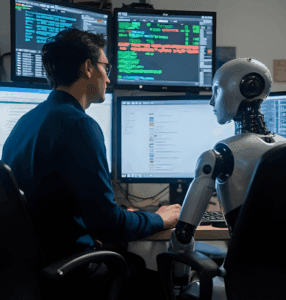
The Harvard Extension School blog writes, “In the AI age, cybersecurity is unlikely to see AI-caused disruption… ‘AI is solving some of our lower-level problems for our security staff, but is it a replacement for them? Not really. Because again, you still need human intervention and you still need people that understand how your organization works.’”
AI accelerates detection. AI supports analysts rather than replacing them. AI strengthens defenses. AI expands what security teams can accomplish.
Cybersecurity is not becoming obsolete- the need for cybersecurity experts isn’t going anywhere.
Will AI Take Over Cybersecurity?
Here is the conclusion:
- AI transforms cybersecurity
- AI automates repetitive tasks
- AI improves accuracy and detection speed
- AI is used by both defenders and attackers
- AI does not replace human experts
Organizations that succeed in the future are the ones that understand this simple truth:
AI is a tool, not a replacement. Humans remain in control. AI does heavy lifting. Cybersecurity has become stronger than ever.
And yes, your cybersecurity team will still have jobs.
(But maybe fewer spreadsheets that make their eyes twitch.)
Final Answer
Will cybersecurity be replaced by AI?
No. AI enhances cybersecurity, it cannot replace human experts.
AI automates repetitive tasks and improves threat detection, but humans remain essential for strategy, judgment, social engineering defense, and responding to complex attacks.
4BIS is here to guide you every step of the way of your cybersecurity process. To learn more watch our podcast on YouTube or listen to us on Spotify.
