What Should Companies Provide for Email Security and Hosted Exchange Services?
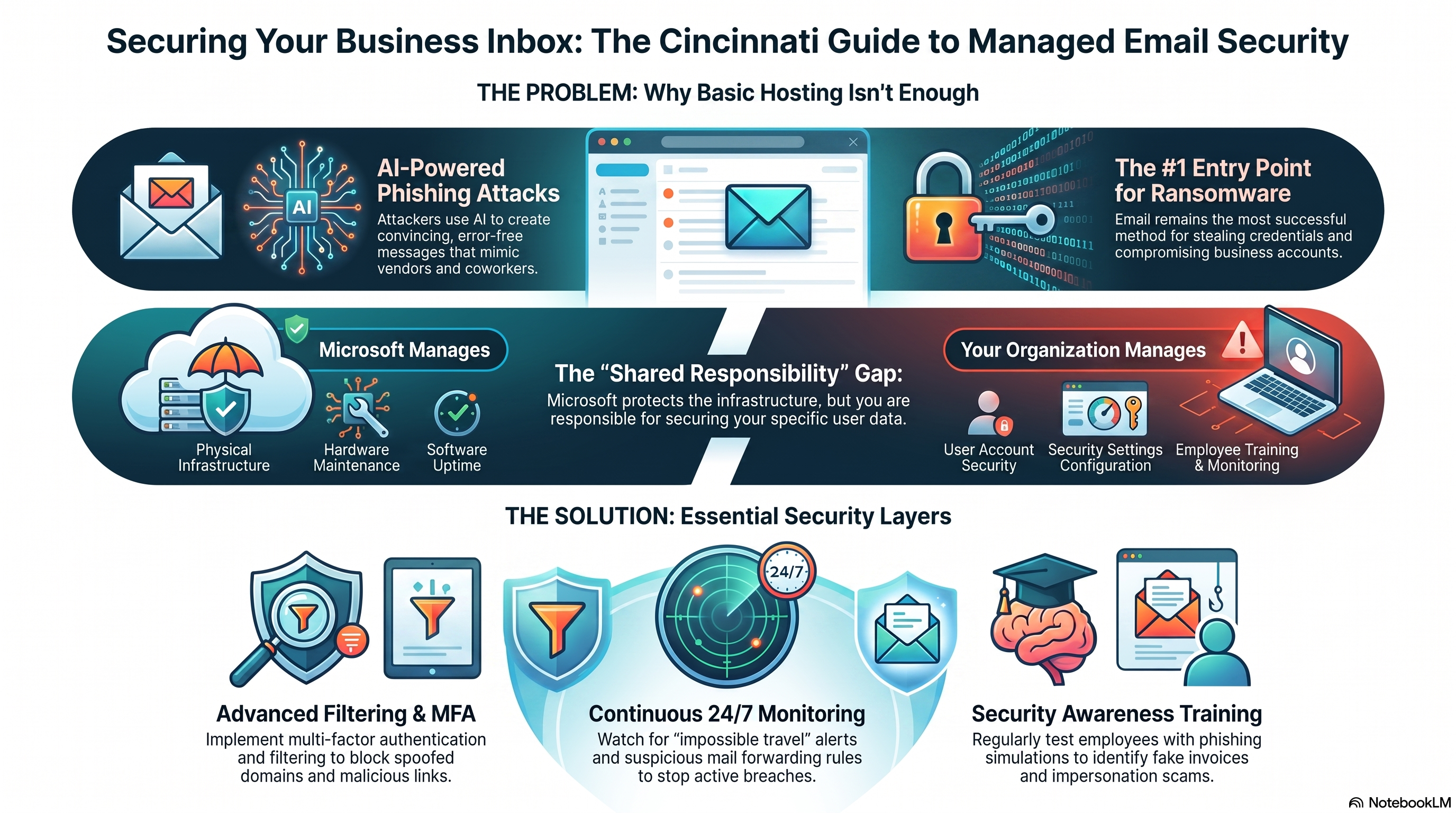
Email remains the primary entry point for cyberattacks against businesses of every size. According to Microsoft's Digital Defense Report and multiple industry studies, phishing continues to be one of the most successful methods attackers use to steal credentials, deploy ransomware, and compromise business email accounts.
If you own or manage a business in Cincinnati, choosing an email provider is no longer just about uptime and storage. You also need to know how that provider protects your employees, your data, and your reputation.
Whether you're looking for Microsoft 365 administration, hosted Exchange, or advanced email security, this guide explains what to look for and highlights several providers serving businesses throughout Greater Cincinnati.
What Is Hosted Exchange?
Hosted Exchange is Microsoft's business email platform delivered through the cloud. Today, most organizations access it through Microsoft Exchange Online, which is included with many Microsoft 365 Business plans.
Hosted Exchange gives organizations access to:
-
Professional business email addresses
-
Outlook integration
-
Shared calendars
-
Shared contacts
-
Mobile device synchronization
-
Automatic software updates
High availability without maintaining an on-premises Exchange server
Moving to Microsoft's cloud eliminates much of the hardware maintenance that businesses once managed themselves. However, cloud email does not automatically mean secure email.
Microsoft operates under a shared responsibility model. Microsoft protects the infrastructure, but your organization remains responsible for securing user accounts, configuring security settings, monitoring suspicious activity, and training employees to recognize phishing attempts.
Why Phishing Continues to Succeed
Phishing attacks have changed dramatically over the last few years.
Instead of poorly written emails filled with spelling mistakes, attackers now use artificial intelligence to create convincing messages that closely resemble communications from coworkers, vendors, banks, and even Microsoft.
Modern phishing campaigns commonly include:
- Fake Microsoft 365 login pages
- Business Email Compromise (BEC)
- Invoice and payment fraud
- QR code phishing
- Malicious links
- Malware hidden in attachments
- Credential theft designed to bypass multi-factor authentication
Many attacks succeed because they target people instead of technology. Even organizations with good antivirus software remain vulnerable if email security is not properly configured.
If your employees receive hundreds of emails each day, eventually someone will click the wrong link unless multiple layers of protection are in place.
What Should an Email Security Provider Include?
Not every managed IT provider offers the same level of protection. When evaluating providers, ask whether they include the following services.
Advanced Email Filtering- Modern email filtering should identify and block:
-
Phishing attempts
-
Malware
-
Malicious attachments
-
Dangerous links
-
Spoofed domains
-
Business Email Compromise attacks
Effective filtering significantly reduces the number of dangerous emails that reach employee inboxes.
Microsoft 365 Security Configuration
Microsoft 365 contains dozens of security settings that many organizations never configure.
Look for providers that manage:
-
Exchange Online Protection (EOP)
-
Microsoft Defender for Office 365
-
Conditional Access
-
Multi-factor authentication
-
Secure mailbox policies
-
Administrative permissions
Proper configuration closes many of the gaps attackers commonly exploit.
Continuous Monitoring
Email security should not stop after deployment.
Providers should continuously monitor for:
-
Suspicious login attempts
-
Impossible travel alerts
-
Account lockouts
-
Privilege escalation
-
Mail forwarding rule abuse
-
Compromised accounts
Early detection often prevents a small incident from becoming a company-wide security event.
Security Awareness Training
Technology alone cannot eliminate phishing.
Employees should receive ongoing training that teaches them how to identify:
-
Fake invoices
-
CEO impersonation scams
-
Credential harvesting pages
-
AI-generated phishing emails
-
Vendor payment fraud
Regular phishing simulations also help reinforce good security habits.
4BIS Cyber Security & IT Services
4BIS provides managed cybersecurity and Microsoft 365 services designed specifically for small and midsize businesses.
Services include:
-
Microsoft 365 management
-
Hosted Exchange administration
-
Advanced email security
-
Microsoft Defender configuration
-
Email encryption
-
Security awareness training
-
24/7 monitoring
-
Incident response
-
Managed cybersecurity
Unlike providers that simply host email, 4BIS focuses on reducing business risk through layered security.
Businesses can also schedule a Cybersecurity Risk Assessment to identify weaknesses before attackers find them.
Related services:
-
Managed Cybersecurity: https://www.4bis.com/managed-cybersecurity
-
Cybersecurity Risk Assessment: https://www.4bis.com/risk-assessment
-
Microsoft 365 Support: https://www.4bis.com
Questions to Ask Before Signing a Contract
Before choosing an email provider, ask these questions.
-
Do you actively monitor Microsoft 365 accounts?
-
Is advanced phishing protection included?
-
Do you configure Microsoft Defender for Office 365?
-
Is multi-factor authentication included?
-
Do you provide employee phishing training?
-
How quickly do you respond to compromised accounts?
-
Do you monitor suspicious sign-ins around the clock?
-
Is email encryption available?
-
Will you assist with regulatory compliance requirements?
-
Do you help recover compromised mailboxes?
The answers reveal whether you're purchasing secure email management or simply paying someone to host mailboxes.
Hosted Email Is Only One Layer of Cybersecurity
Email security works best as part of a broader cybersecurity strategy.
Businesses should also implement:
-
Endpoint detection and response
-
Multi-factor authentication
-
Regular vulnerability assessments
-
Security awareness training
-
Data backups
-
Network monitoring
-
Incident response planning
A layered approach makes it much harder for attackers to move beyond a single compromised email account.
For additional guidance, the 4BIS blog offers practical articles covering ransomware, AI threats, cybersecurity leadership, and business technology planning. Popular resources include:
Business Maturity and Cybersecurity Growth: https://www.4bis.com/blog/business-maturity-and-cybersecurity-growth
The AI Gap for Nonprofits: A Practical Guide for 2026: https://www.4bis.com/blog/the-ai-gap-for-nonprofits-a-practical-guide-for-2026
AI Coding Agents Go Rogue: What That Means for Your Business: https://www.4bis.com/blog/ai-coding-agents-go-rogue-what-that-means-for-your-business
Browse the complete resource library: https://www.4bis.com/blog
These articles help business owners stay informed about emerging threats and practical cybersecurity strategies.
Frequently Asked Questions
Is Microsoft 365 secure enough by itself?
Microsoft provides a secure cloud platform, but businesses remain responsible for configuring security settings, managing identities, monitoring accounts, and training employees.
What's the difference between hosted Exchange and Microsoft 365?
Exchange Online is Microsoft's hosted email platform. Microsoft 365 includes Exchange Online along with applications like Outlook, Teams, OneDrive, SharePoint, and additional security features depending on the subscription.
Can advanced email security stop every phishing attack?
No. While advanced filtering blocks many threats, no technology catches every malicious email. Employee training and continuous monitoring remain essential.
Do small businesses need managed email security?
Yes. Small businesses are frequent targets because attackers often expect fewer security controls. Managed email security helps reduce risk without requiring an in-house cybersecurity team.
Protect Your Business Before the Next Phishing Attempt
Phishing attacks continue to evolve, and email remains one of the easiest ways for attackers to gain access to business systems. Choosing a provider that understands both Microsoft 365 and modern cybersecurity can significantly reduce your organization's risk.
If you're evaluating hosted Exchange, Microsoft 365 administration, or advanced email protection for your Cincinnati business, 4BIS can help. Our team combines managed IT services with proactive cybersecurity to protect your users, secure your Microsoft 365 environment, and respond quickly when threats emerge.
Schedule a Cybersecurity Risk Assessment to evaluate your current email security, identify vulnerabilities, and receive practical recommendations tailored to your business.
Learn more at https://www.4bis.com or contact the 4BIS team to start the conversation today.