.png)
Many small and mid-sized businesses believe hiring a single internal IT employee is the most cost-effective way to manage technology.
At first glance, the math seems simple. One salary appears to be less expensive than building a larger IT team or partnering with a managed IT provider.
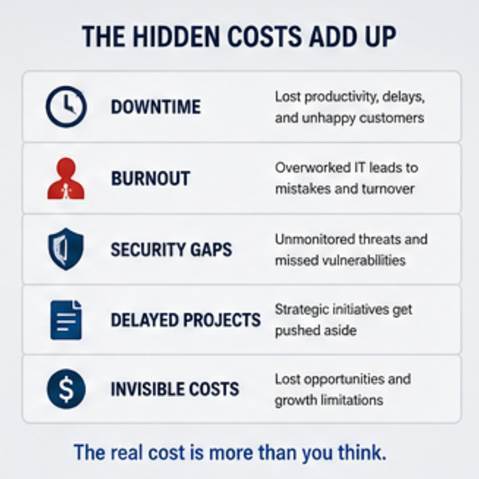
However, many organizations fail to recognize the hidden operational, financial, and cybersecurity costs that develop when one person becomes responsible for the entire technology environment.
Modern business technology has evolved far beyond basic computer support. Today’s environments require continuous monitoring, cybersecurity management, cloud administration, vendor coordination, backup oversight, compliance support, and strategic planning.
As responsibilities continue expanding, businesses that rely on one internal IT employee often become reactive instead of proactive.
The result is increased downtime, delayed projects, cybersecurity gaps, employee frustration, and operational risk.
One Person Cannot Realistically Handle Every IT Responsibility
Internal IT professionals work extremely hard. The problem is not effort or dedication. The problem is capacity.
One employee cannot effectively manage:
- User support
- Cybersecurity monitoring
- Vendor management
- Network administration
- Cloud infrastructure
- Strategic planning
- Compliance requirements
- Backup management
- Employee onboarding
- Software licensing
- Hardware replacement planning
- After-hours emergencies
At some point, priorities begin competing against one another. Immediate issues such as password resets, internet outages, and troubleshooting requests consume time that should be spent on proactive maintenance and long-term planning.
Eventually, businesses fall into a constant break-fix cycle. Instead of preventing issues, the IT department spends most of its time reacting to problems after they occur.
Businesses looking to move beyond reactive IT support can learn more about proactive technology management.
Downtime Costs More Than Most Businesses Realize
When IT environments lack sufficient support, problems often take longer to resolve. That delay affects nearly every part of the business.
Employees may lose access to:
- Shared files
- Cloud applications
- Customer databases
- Accounting systems
- Communication platforms
Even small interruptions create productivity losses that accumulate over time.
Downtime also impacts:
- Customer response times
- Sales operations
- Internal communication
- Employee morale
- Revenue-generating activities
For many organizations, the hidden cost is not the IT salary itself. The hidden cost is the lost productivity caused by limited support capacity.
Cybersecurity Often Gets Pushed Aside
One of the most dangerous hidden costs of a one-person IT department involves cybersecurity.
When one employee manages every operational responsibility, cybersecurity tasks often become secondary priorities.
Critical activities may become delayed or inconsistent, including:
- Vulnerability management
- Patch management
- Multi-factor authentication enforcement
- Security awareness training
- Backup testing
- Endpoint monitoring
- Access reviews
- Incident response planning
Unfortunately, cybercriminals actively target small and mid-sized businesses because they often lack dedicated cybersecurity resources.
According to the Federal Bureau of Investigation Internet Crime Complaint Center, ransomware, phishing, and business email compromise attacks continue increasing against organizations of all sizes.
Burnout Creates Business Risk
Technology environments require constant attention. Servers fail overnight. Security alerts happen on weekends. Employees need support during onboarding, remote work transitions, and emergencies.
When one employee carries full responsibility for the environment, burnout becomes increasingly likely.
Burnout creates serious business problems, including:
- Slower response times
- Missed security updates
- Deferred maintenance
- Incomplete documentation
- Increased turnover risk
- Reduced strategic planning
- Higher operational stress
Ironically, businesses attempting to reduce costs with minimal staffing often create greater long-term financial and operational risk.
The Documentation Problem
Many one-person IT departments unintentionally rely on memory instead of documented processes.
This becomes a major issue when:
- Employees leave
- Systems fail
- Vendors need coordination
- Cybersecurity incidents occur
- Leadership needs visibility
- Recovery procedures become necessary
Without proper documentation, businesses may struggle to access:
- Administrative passwords
- Firewall configurations
- Backup systems
- Software licensing records
- Vendor contracts
- Cloud account information
- Recovery procedures
Documentation is not optional in modern IT environments.
Strong documentation improves:
- Business continuity
- Incident response
- Employee transitions
- Disaster recovery
- Operational stability
Businesses should maintain updated documentation for networks, backups, credentials, vendors, hardware, software, and recovery procedures.
Cybersecurity Threats Continue Expanding
Cybersecurity has become significantly more complex over the last several years.
Businesses now face threats such as:
- Ransomware
- Credential theft
- Business email compromise
- Phishing attacks
- Data breaches
- Insider threats
- Cloud security risks
- Supply chain attacks
Managing cybersecurity effectively requires specialized expertise and continuous monitoring. One internal employee rarely has enough time to manage operational support while also defending against modern cyber threats.
Organizations that strengthen cybersecurity often supplement internal teams with:
- Managed Detection and Response (MDR)
- Security monitoring
- Vulnerability management
- Security awareness training
- Incident response planning
- Compliance support
Learn more about MDR services.
Strategic Planning Often Gets Delayed
Businesses frequently overlook another hidden cost of one-person IT departments. Strategic planning often disappears.
When IT employees spend most of their time handling daily issues, they rarely have enough time for:
- Infrastructure upgrades
- Long-term budgeting
- Cloud migration planning
- Cybersecurity improvements
- Lifecycle management
- Compliance initiatives
- Business continuity planning
This creates aging infrastructure, inconsistent technology standards, and reactive decision-making.
Over time, businesses become less efficient and more vulnerable to outages and cyber incidents.
Why Co-Managed IT Support Helps Businesses Scale
Many organizations do not need to replace their internal IT employees. Instead, they need additional support.
Co-managed IT services help businesses strengthen operations by providing:
- Additional expertise
- Proactive monitoring
- Cybersecurity oversight
- After-hours support
- Strategic planning assistance
- Documentation support
- Specialized engineers
- Backup management
This approach allows internal employees to focus on core business needs while reducing operational stress and cybersecurity risk.
Businesses gain access to a broader team with expertise across networking, cybersecurity, cloud systems, compliance, and infrastructure management.
Signs Your Business Has Outgrown a One-Person IT Department
Many organizations do not recognize warning signs until operational issues become severe.
Common indicators include:
- Employees wait too long for support
- Cybersecurity projects remain unfinished
- Documentation is incomplete or missing
- Backups are not regularly tested
- Downtime occurs repeatedly
- Leadership lacks visibility in IT operations
- Technology projects stall
- One employee handles every emergency
- Vendors rely on a single point of contact
If these situations sound familiar, your business may already face unnecessary operational and cybersecurity risk.
Technology Is Too Important to Rely on One Person
Technology now supports nearly every area of business operations.
Communication, accounting, customer service, remote work, cloud applications, cybersecurity, and collaboration tools all depend on properly managed infrastructure.
That level of responsibility should never fall entirely on one employee.
Businesses that invest in layered support models improve:
- Operational resilience
- Cybersecurity visibility
- Business continuity
- Employee productivity
- Long-term scalability
The goal is not to replace internal IT staff. The goal is to reduce risk and create a stronger support structure.
Strengthening Your IT and Cybersecurity Strategy
If your business relies heavily on one IT employee, now is the time to evaluate the operational and cybersecurity risks that may already exist inside your environment.
4BIS helps businesses improve IT support, cybersecurity visibility, monitoring, documentation, and long-term technology planning through managed and co-managed IT services.
Contact 4BIS today to schedule a consultation and learn how to reduce downtime, improve security, and build a more resilient IT environment.