
Most internal IT teams start every day reacting to problems.
Password resets, onboarding employees, troubleshooting devices, managing software updates, coordinating vendors, resolving outages, and supporting users consume hours of time before cybersecurity projects even begin.
For many small and mid-sized businesses, internal IT teams operate in a constant state of reaction.
Unfortunately, cybercriminals do not slow down simply because businesses are busy.
As ransomware attacks, phishing campaigns, credential theft, and compliance requirements continue increasing, many organizations are discovering a dangerous reality.
Critical cybersecurity tasks often remain delayed, deprioritized, or overlooked because internal IT teams simply do not have enough time.
Traditional IT Support and Cybersecurity Are Different Responsibilities
Many businesses still assume cybersecurity is just another part of IT support.
Operational IT and cybersecurity require different priorities and skill sets.
Traditional IT focuses on:
- Keeping systems operational
- Supporting employees
- Maintaining uptime
- Managing infrastructure
- Troubleshooting problems
Cybersecurity focuses on:
- Threat detection
- Risk reduction
- Continuous monitoring
- Vulnerability management
- Incident response
- Access control
- Security policy enforcement
- Compliance management
Even highly skilled internal IT employees often struggle to balance both responsibilities simultaneously. The issue is rarely motivation. The issue is bandwidth.
Vulnerability Management Often Falls Behind
One of the most important cybersecurity responsibilities involves identifying and remediating vulnerabilities before attackers exploit them.
This includes:
- Operating system updates
- Software patching
- Firmware updates
- Endpoint remediation
- Unsupported system identification
- Firewall review
- Cloud security assessments
In overloaded IT environments, patching often becomes reactive instead of proactive.
That delay creates opportunities for attackers to exploit known vulnerabilities that already have publicly available fixes.
The Cybersecurity & Infrastructure Security Agency regularly warns businesses about attackers targeting unpatched systems because they remain one of the easiest entry points for ransomware and malware attacks.
Security Monitoring Requires Continuous Attention
Cybersecurity threats do not operate during business hours only.
Suspicious login attempts, malware activity, phishing attacks, and unusual network traffic can happen at any time.
Effective monitoring requires:
- Log analysis
- Threat correlation
- Endpoint visibility
- Alert review
- Rapid investigation
- Incident escalation
Most internal IT teams do not have enough staffing to monitor environments continuously while also supporting daily business operations.
As a result, critical alerts may go unread or unresolved for extended periods.
Backup Testing Is Frequently Overlooked
Many businesses assume backups are working because backup software reports successful jobs.
However, successful backups do not always mean successful recovery.
Cybersecurity-focused backup management should include:
- Recovery testing
- Backup validation
- Ransomware resilience checks
- Disaster recovery planning
- Immutable backup strategies
- Recovery time testing
Without regular testing, businesses may discover backup failures only after ransomware or major outages occur.
Organizations that fail to test recovery procedures often experience longer downtime and higher financial losses during incidents.
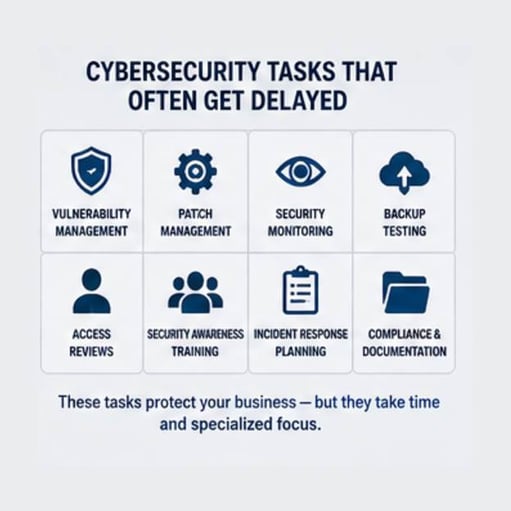 Access Management Requires Ongoing Review
User accounts and permissions change constantly.
Over time, many businesses accumulate:
- Former employee accounts
- Excessive permissions
- Shared credentials
- Unused administrator accounts
- Weak authentication practices
Regular access reviews help reduce insider threats and limit attacker movement during a cyber incident.
Unfortunately, these reviews often get delayed because they require time, coordination, and consistent oversight.
Security Awareness Training Gets Delayed
Employees remain one of the most targeted attack vectors for cybercriminals.
Phishing emails, fake invoices, malicious links, and credential theft attempts continue increasing across organizations of every size.
Ongoing security awareness training helps employees:
- Identify phishing attempts
- Avoid malicious attachments
- Report suspicious activity
- Reduce human error
- Improve incident reporting
Unfortunately, many businesses conduct training infrequently or not at all because internal IT teams remain overwhelmed by operational demands.
Businesses that invest in employee cybersecurity awareness reduce the likelihood of successful phishing attacks and credential theft.
Incident Response Planning Rarely Gets Enough Attention
Many organizations do not develop formal incident response procedures until after a cybersecurity event occurs.
An effective incident response plan should define:
- Roles and responsibilities
- Escalation procedures
- Communication plans
- Vendor coordination
- Recovery priorities
- Legal considerations
- Compliance requirements
Without preparation, businesses often lose valuable time during cyber incidents when rapid decision-making matters most. Organizations that proactively plan for incidents to recover faster and reduce operational disruption.
Compliance Requirements Add Additional Pressure
Businesses operating in regulated industries face additional cybersecurity responsibilities.
Compliance requirements may involve:
- Risk assessments
- Security policies
- Audit preparation
- Access controls
- Documentation standards
- Data retention requirements
- Endpoint security controls
These responsibilities require significant time and specialized expertise. For overloaded internal IT teams, compliance work often becomes another competing priority added to an already demanding workload.
Why Cybersecurity Requires Dedicated Resources
Modern cybersecurity is no longer something businesses can manage casually or only address when time allows.
Protecting business systems requires:
- Continuous monitoring
- Proactive threat management
- Specialized expertise
- Layered defenses
- Incident response preparation
- Ongoing testing and validation
Organizations that rely entirely on overwhelmed internal IT teams often develop cybersecurity gaps unintentionally over time.
How Managed Security Services Support Internal IT Teams
Many businesses improve cybersecurity outcomes by supplementing internal IT staff with outside expertise and monitoring.
This may include:
- Managed Detection and Response (MDR)
- Threat monitoring
- Vulnerability management
- Incident response support
- Backup oversight
- Security awareness training
- Co-managed IT services
This approach allows internal teams to focus on operational support while strengthening overall cybersecurity visibility.
Signs Your IT Team May Be Overwhelmed
Many businesses already experience warning signs that cybersecurity responsibilities are falling behind.
Common indicators include:
- Delayed patching
- Recurring security alerts
- Incomplete documentation
- Limited monitoring visibility
- Delayed technology projects
- Reactive cybersecurity management
- Backup testing gaps
- Employee complaints about slow support
- No formal incident response plan
If these situations sound familiar, your organization may already face elevated cybersecurity risk.
Build a Stronger Cybersecurity Strategy
Technology and cybersecurity have become too important for overloaded internal teams to manage alone.
Businesses that combine internal IT support with proactive cybersecurity expertise improve:
- Threat visibility
- Operational stability
- Incident response readiness
- Employee productivity
- Business continuity
- Long-term resilience
4BIS helps businesses strengthen cybersecurity, monitoring, IT support, documentation, and technology strategy through managed and co-managed services.
Contact 4BIS today to schedule a consultation and learn how to reduce cybersecurity risk while improving operational efficiency.