Your Business Network Needs More Than One IT Person
Most business owners assume their network is fine.
You've got Wi-Fi, a firewall, maybe someone who handles IT such as a family member, a longtime employee, or spouse. The system seems to work. Nothing has happened, so maybe you’re okay.
A working network and a secure network are two different setups, and it's easy to confuse them until something goes wrong.
One of the most common vulnerabilities we find when we assess small and mid-sized businesses is that everything is connected to everything else. Computers, printers, cameras, guest Wi-Fi, servers, smart TVs, phones, sometimes even the HVAC system, all sharing the same network with no meaningful barriers between them. That's a setup that makes lateral movement trivially easy for an attacker. And in most cases, it exists because one person was handed the keys to IT and did their best with what they had.
What Network Segmentation Actually Means
Segmentation is the practice of dividing your network into separate zones with controlled access between them.
The classic analogy is a building with doors locked between departments. Without segmentation, your office has one giant open floor. If someone gets in, they can wander anywhere. With it, a breach in one area doesn't automatically expose the rest.
In practical terms, that means:
- A compromised printer shouldn't provide access to your accounting server
- Guest Wi-Fi users shouldn't be able to see internal devices
- A ransomware infection on one laptop shouldn't be able to reach your backups
- Security cameras shouldn't have any reason to communicate with payroll systems
Good segmentation contains the damage. It won't stop every attack, but it limits how far one gets.
Businesses looking to improve their network infrastructure can learn more about network installation and network security services.
Why This Matters More Than It Used To
Attackers almost never breach a network and immediately land on their target. Hackers gain access through a vulnerable device, a phishing click, or a misconfigured service, and then move laterally, looking for the valuable data or a way to direclty steal money.
Without the proper setup, gaining access is easy. There are no barriers to stop a hacker from doing whatever they want once on your network.
NIST's small business cybersecurity guidance highlights limiting access between systems as a foundational risk-reduction measure. Network segmentation limits how much damage a single-entry point can cause.
It also helps with ransomware specifically, which spreads aggressively across connected systems. A well-segmented network can mean the difference between an isolated incident and a company-wide shut down.
For businesses where uptime matters, segmentation also supports stronger business continuity planning.
Warning Signs Your Network Might Not Be Segmented
Most businesses don't know there's a problem until something bad happens. A few things worth looking at:
If any device can see any other device.
If an employee can browse printers, cameras, servers, and shared drives from a single machine without any restrictions, the network isn't secure.
IoT and smart devices share your main network.
Cameras, conference room screens, thermostats. These devices often have weak security and receive infrequent updates. They don't belong on the same segment as your servers.
Remote workers connect without restrictions.
If a remote employee can reach every internal system the moment they connect, the network isn't limiting exposure. It's just moving it outside the office.
Nobody has touched the network architecture in years.
A setup designed for a 10-person office without cloud tools or remote workers looks very different from what's secure today. If your business has grown but the underlying network design hasn't changed, there are almost certainly gaps.
Businesses struggling to scale technology securely often benefit from managed IT services.
Why Securing a Network Is a Team Sport
This is where the one IT person model tends to break down, and it's worth being honest about why.
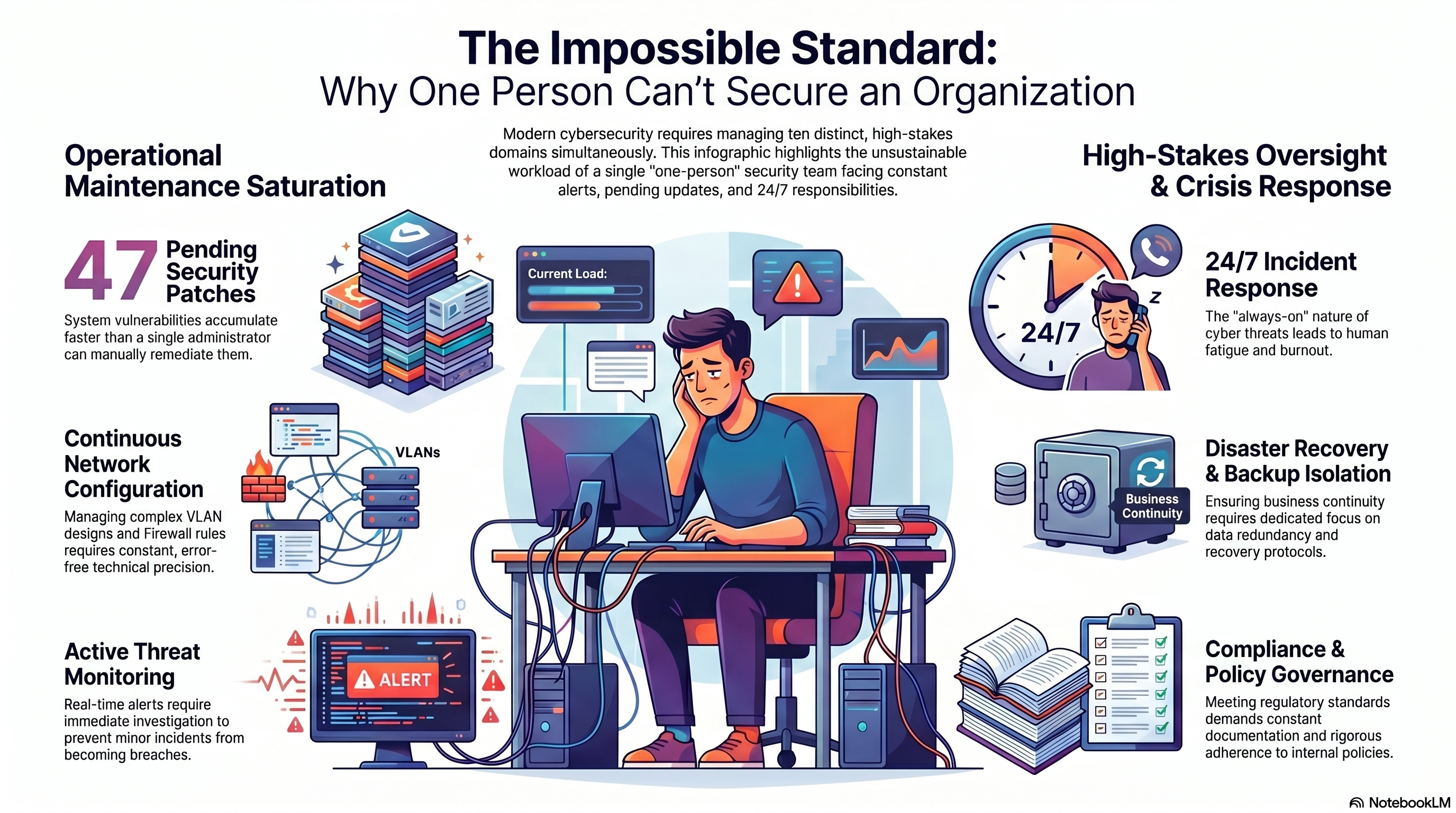
A single person (no matter how capable) who covers an enormous amount of continously evolving security. Managing firewall configurations, VLANs, access control policies, patching, threat monitoring, compliance, backups, disaster recovery, and the constantly evolving ransomware landscape is simply too much for one person to handle.
We regularly work with businesses where an internal employee or a well-meaning contractor handles IT for years. The systems functions until a phishing email hit, or a camera with outdated firmware became an entry point. Suddenly a single small compromise cascaded across an unsegmented network.
The problem usually isn't that the person isn't good at their job. It's that no one person can maintain deep expertise across every layer of a modern business network. Security, infrastructure, compliance, and monitoring are genuinely different disciplines. The people who do this well do it in teams, with defined areas of focus and someone whose only job is to look for what everyone else might have missed.
That's why more businesses are shifting toward managed IT and cybersecurity support rather than putting everything on one person's plate. This shift is covered in more detail in this guide to managing IT services for small businesses.
What a Properly Segmented Network Looks Like
A solid setup typically maintains separate zones for employee workstations, servers, guest Wi-Fi, VoIP phones, security cameras, printers, IoT devices, backup systems, and remote access connections. Department-specific systems often get their own segmentation as well.
Equally important are the rules governing how those zones interact. Guest Wi-Fi should reach the internet and nothing else. Cameras should talk to recording servers and nothing else. Backups should be isolated from standard user access entirely.
Those restrictions are what give segmentation its value. Without enforced rules between zones, you just have a more complicated flat network.
How to Find Out Where You Stand
The most reliable answer is a professional network assessment, that is conducted by a team rather than a single generalist.
A qualified IT and cybersecurity team can review your network architecture, firewall rules, VLAN configuration, user permissions, remote access policies, wireless security, device segmentation, and backup isolation. They'll surface problems that may have existed for years without being visible.
Most businesses that go through this process find at least a few significant gaps. Technology and threat landscapes change fast, and what was reasonable five years ago may be a liability now.
A team brings multiple perspectives to the review, and someone is always accountable for the parts that could otherwise fall through the cracks.
Companies concerned about cybersecurity risks can also explore managed cybersecurity and IT support services.
Final Thoughts
If your network is one big, shared environment with no separation between systems, your exposure is probably higher than you realize. Segmentation is one of the most practical things a business can do to limit the impact of an attack, and it's much cheaper to implement before an incident than to wish you'd done it after.
At 4BIS Cyber Security & IT Services, we help businesses throughout Cincinnati design networks that are secure, scalable, and manageable. If you're not sure where your network stands, a conversation is a good place to start.