What Anthropic’s “Mythos” Means for Cybersecurity
Artificial intelligence is advancing rapidly, but not all progress is purely beneficial. A new AI model from Anthropic, referred to as “Mythos,” is raising serious concerns in the cybersecurity community.
This development will likely change how attackers discover, execute, and defend against cyberattacks.
What Is Anthropic’s Claude AI?
Claude is a generative AI platform developed by Anthropic that specializes in advanced reasoning, coding, and technical problem solving.
Unlike general-purpose AI tools, Claude is widely used for:
- Software development
- Code analysis
- Complex system troubleshooting
This makes it especially powerful in technical environments, including cybersecurity.
What Is the Mythos Model?
Mythos is a newer and more advanced version of Claude. Claude is showing to be a faster and significantly better at identifying system vulnerabilities.
Key capabilities include:
- High-speed vulnerability detection
- Advanced code analysis
- Automated security testing
While these features can improve defense, they also introduce new risks.
What Is a Zero-Day Vulnerability?
A zero-day vulnerability occurs when attackers identify a security flaw before the software vendor realizes the vulnerability. Therefore, the vulnerability might be found before a fix can be created.
Key characteristics:
- No existing patch
- Immediate exploitation risk
- Often highly valuable to attackers
These vulnerabilities are among the most dangerous in cybersecurity.
Why Is AI-Driven Vulnerability Discovery a Risk?
AI can discover vulnerabilities faster than organizations can fix them, creating a dangerous security gap.
With tools like Mythos:
- Thousands of vulnerabilities can be identified quickly
- Exploits can be developed rapidly
- Attack timelines shrink from weeks to minutes
This creates a scenario where defenders are constantly behind.
How Does AI Change Cyberattacks?
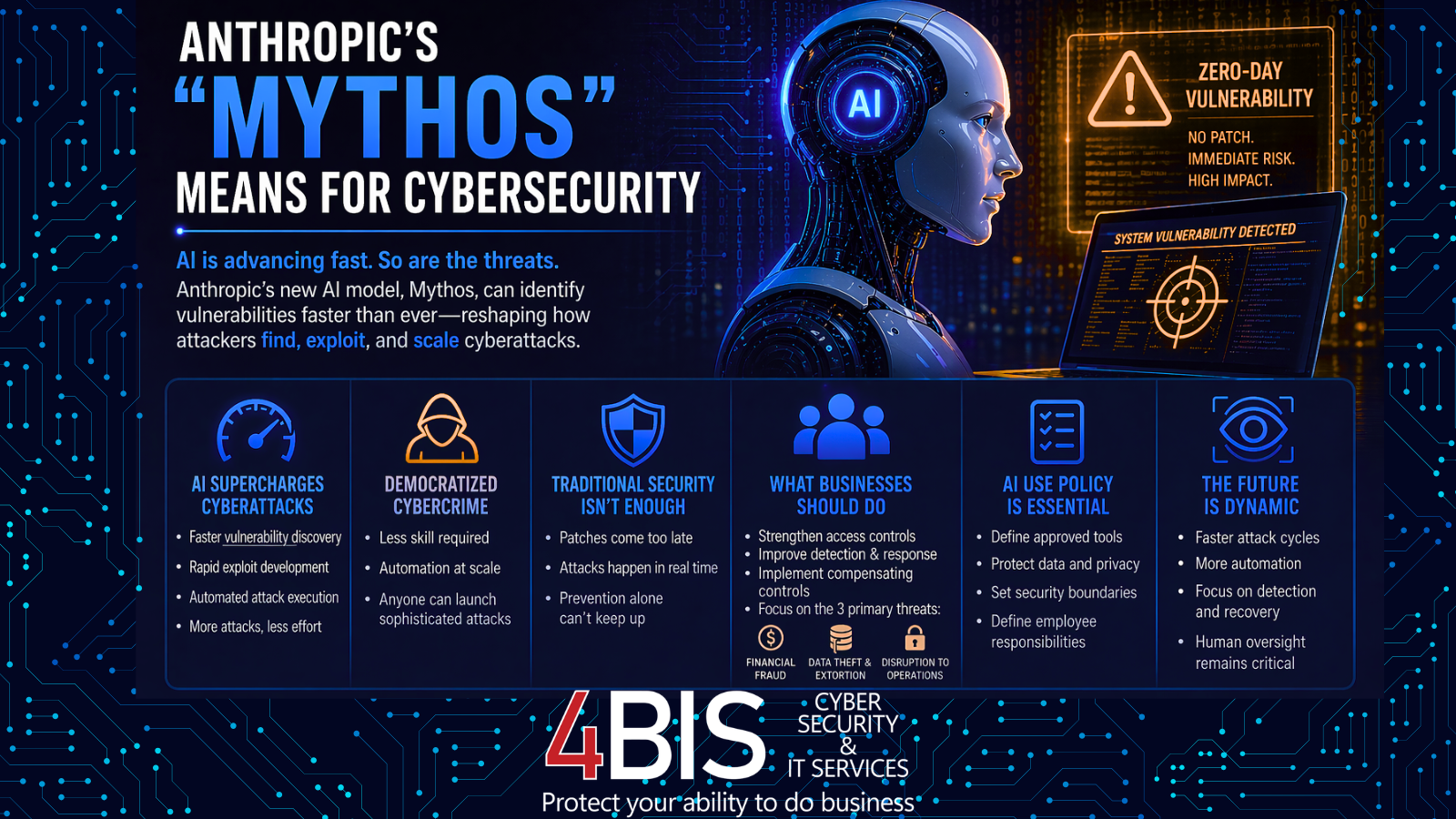
AI accelerates both the speed and scale of cyberattacks, making them more automated and harder to stop.
Key impacts:
- Faster exploitation of vulnerabilities
- Automated attack execution
- Reduced need for human hackers
- Increased attack volume
This shift is often referred to as democratized cybercrime.
What Is Democratized Cybercrime?
Democratized cybercrime means that advanced hacking capabilities are no longer limited to highly skilled attackers.
AI enables:
- Less experienced attackers to launch complex attacks
- Automation of traditionally manual processes
- Scalable attacks across thousands of targets
As a result, businesses of all sizes are at risk.
Why Traditional Cybersecurity Is No Longer Enough
Relying only on patching and antivirus tools is no longer sufficient in an AI-driven threat landscape.
The old model:
- Patch vulnerabilities
- Install endpoint protection
- Assume coverage
The new reality:
- Vulnerabilities are discovered faster than patches
- Attacks happen in real time
- Prevention alone cannot keep up
What Should Businesses Do to Stay Protected?
Organizations must adopt a proactive and adaptive cybersecurity strategy focused on detection, response, and resilience.
Focus on the Three Primary Threats
- Financial fraud
- Data theft and extortion
- Disruption to operations (ransomware)
Strengthen Access Controls
- Limit user permissions
- Protect sensitive data
- Use multi-factor authentication
Improve Detection and Response
- Monitor systems continuously
- Identify unusual behavior quickly
- Respond in real time
Implement Compensating Controls
- Add layers of security beyond patching
- Create barriers that slow attackers down
Treat Cybersecurity as a Business Risk
- Align security with business operations
- Allocate proper budget and resources
How Important Is an AI Use Policy?
An AI use policy is essential for managing risk and ensuring safe adoption of AI tools within an organization.
A strong policy should define:
- Approved tools and use cases
- Data privacy guidelines (including AI policies)
- Security boundaries
- Employee responsibilities
Without clear policies, AI can introduce unintended vulnerabilities.
What Does the Future of Cybersecurity Look Like?
Cybersecurity will become more dynamic, requiring continuous adaptation as AI capabilities evolve.
Key trends:
- Faster attack cycles
- Increased reliance on automation
- Greater focus on detection and recovery
- Ongoing need for human oversight
Organizations must remain flexible and responsive to keep up.
FAQ: AI and Cybersecurity Risks
Below is an FAQ section optimized for search engines and voice assistants.
What is Anthropic’s Mythos AI?
Mythos is an advanced AI model developed by Anthropic that excels at identifying software vulnerabilities and analyzing code.
Why is Mythos considered a cybersecurity risk?
It can discover and potentially exploit vulnerabilities faster than organizations can patch them, increasing the risk of cyberattacks.
What is a zero-day vulnerability?
A zero-day vulnerability occurs when attackers uncover a previously unknown flaw and exploit it before a patch becomes available. The result is that many individuals and businesses could become victims to more cyber attacks.
How does AI make hacking easier?
AI automates tasks like vulnerability discovery and exploit development, reducing the skill required to perform cyberattacks.
Can small businesses become victims to an AI-driven attacks?
Yes. AI enables attackers to scale operations, making businesses of all sizes potential targets.
What is the best way to protect against AI-driven cyber threats?
A layered cybersecurity approach that includes detection, response, access control, and continuous monitoring is the most effective defense.
Final Thoughts
AI is reshaping cybersecurity faster than most organizations can get prepared.
If your current strategy still relies heavily on patching and prevention alone, it is time to reassess.
4BIS can help you:
- Evaluate your current cybersecurity posture
- Build a resilient, modern security program
- Prepare for the realities of AI-driven threats
Contact 4BIS today to start building a cybersecurity strategy that keeps up with what’s next.