Cyber insurance exists to protect your business when the worst happens. But thousands of organizations discover each year that paying a premium does not guarantee a payout. When a ransomware attack, data breach, or business email compromise occurs, insurance carriers conduct detailed post-incident investigations and if required security controls were missing, misrepresented, or not functioning, your claim can be reduced or denied entirely.
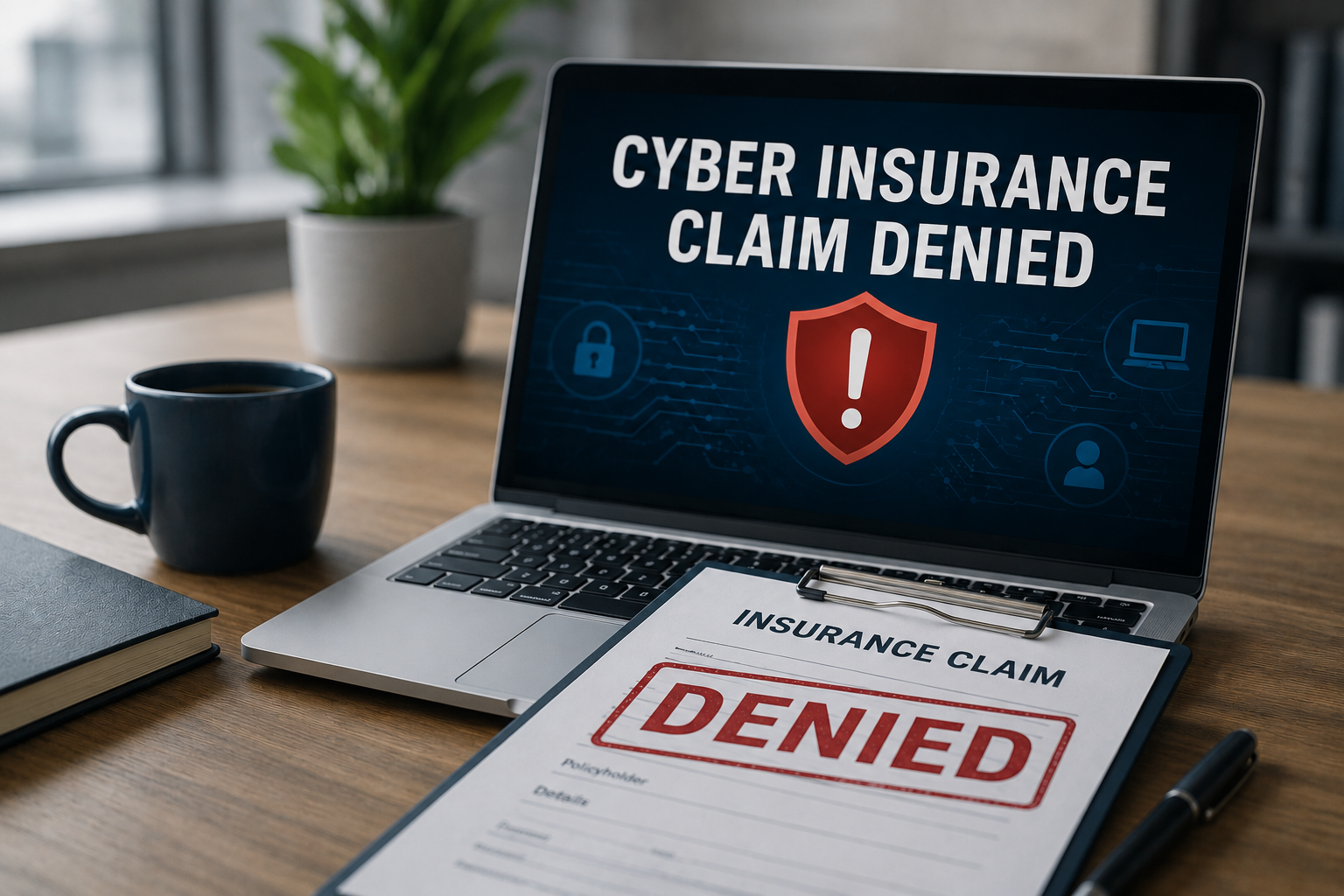
Why Cyber Insurance Claims Get Denied
Cyber insurance policies contain specific requirements called warranties, conditions, or minimum-security standards that define the security posture a business must maintain to be eligible for coverage. When insurers investigate a claim and find those requirements were unmet, they have legal grounds to contest or deny the payout.
The most common reasons cyber insurance claims are denied include:
1. Missing Multi-Factor Authentication (MFA)
MFA is now a baseline requirement across nearly every major cyber insurance carrier. Insurers expect MFA to be enabled on email accounts, remote access tools, administrative accounts, and cloud applications. If a breach occurs because MFA was not in place and the policy application stated it was the insurer may deny the claim on grounds of misrepresentation or failure to meet policy conditions.
2. Inadequate or Untested Backup Practices
Backups alone are not enough. Insurers expect organizations to maintain backups that are tested regularly, stored separately from production systems (including offline or immutable copies), and capable of restoring critical systems within defined recovery time objectives. Ransomware victims who cannot demonstrate verified backup procedures often face reduced settlements.
3. Failure to Apply Security Patches
Unpatched software remains one of the most exploited attack vectors. When a breach results from a known vulnerability that had an available patch, insurers may argue the organization failed to meet basic security hygiene expectations. A documented patch management program is increasingly considered a minimum requirement, not a best practice.
4. Lack of Employee Security Awareness Training
Human error drives most cyber incidents. Phishing attacks, credential theft, and fraudulent wire transfers typically begin with a single employee action. Insurance carriers increasingly require documentation, recurring security awareness training not a one-time onboarding session.
5. Misrepresentation on the Insurance Application
Insurance applications contain detailed technical questions about security controls. When organizations answer those questions without fully understanding what is implemented or overstate their security posture insurers may treat the discrepancy as misrepresentation. This is one of the most common and most damaging reasons claims are denied.
What Cyber Insurers Require in 2026
Cyber insurance underwriting has changed significantly over the past several years. What was once a questionnaire has become a technical audit. Organizations seeking favorable coverage terms and organizations that want their claims paid should expect scrutiny across the following areas:
Multi-Factor Authentication (MFA) Required for all critical systems: email, cloud applications, remote access, and privileged user accounts. Partial MFA deployment is increasingly insufficient.
Endpoint Detection and Response (EDR) Traditional antivirus software no longer meets insurer expectations. EDR platforms provide real-time threat detection, behavioral analysis, and response capabilities that legacy tools cannot match.
Security Monitoring and Logging Insurers want evidence that suspicious activity is detected quickly. Continuous monitoring, log retention, and alerting capabilities demonstrate that an organization has visibility in its environment.
Documented Incident Response Plan A written, tested incident response plan signals organizational maturity. Insurers increasingly ask whether plans have been exercised through tabletop drills or simulated incidents.
Backup and Recovery Testing Carriers want more than backup confirmation. They expect documented evidence that backups are tested, recovery timelines are validated, and backup systems are protected from ransomware encryption.
Vendor and Third-Party Risk Management Third-party vendors with access to sensitive data or internal systems represent meaningful risk. Insurers increasingly ask how organizations evaluate and manage vendor cybersecurity posture.
How Cybersecurity Frameworks Strengthen Insurability
Organizations that align with recognized cybersecurity frameworks are better positioned to demonstrate security maturity to insurers, regulators, and customers. Most major cyber insurance carriers now align their underwriting criteria with these standards:
NIST Cybersecurity Framework 2.0 The most widely recognized framework for managing cybersecurity risk. The 2.0 update added a Govern function that emphasizes leadership accountability, risk strategy, and supply chain security areas insurers are increasingly focused on.
CMMC (Cybersecurity Maturity Model Certification) Required for organizations supporting the Department of Defense supply chain. The controls required for CMMC certification significantly overlap with cyber insurance requirements and position organizations well for both.
HIPAA Security Rule Healthcare organizations subject to HIPAA must implement technical, administrative, and physical safeguards that align closely with cyber insurance minimum standards.
Ohio Safe Harbor Law Ohio's Data Protection Act provides an affirmative legal defense for businesses that implement and maintain a recognized cybersecurity framework. Organizations operating in Greater Cincinnati should understand how Safe Harbor status can strengthen both their legal position and their overall cybersecurity posture.
Real-World Example: When a Claim Gets Denied
Consider a mid-sized manufacturer that suffers a ransomware attack. Production systems go offline. Customer orders stall. The organization files a claim expecting their cyber insurance to cover downtime losses, remediation costs, and recovery expenses.
During the post-incident investigation, the insurer reviews security configurations and discovers that administrative accounts did not have MFA enabled. The application the organization submitted at renewal stated that MFA protected all privileged accounts.
The insurer now has grounds to contest the claim based on two potential issues: failure to maintain required controls, and material misrepresentation on the application.
Outcomes in situations like this vary depending on policy language, carrier, and specific circumstances. But the pattern is consistent: the organizations that face denied or disputed claims are almost always the ones that implemented security controls for compliance purposes only without verifying those controls were functioning and accurately documented.
The lesson: Security controls must be implemented, monitored, tested, and accurately represented not just checked off on a renewal form.
Questions to Ask Your Insurance Agent Before a Breach Occurs
Business leaders should not learn about policy requirements during a claims investigation. Ask your insurance agent or broker these questions now:
- Which cybersecurity controls are required for full coverage under our current policy?
- Which controls are mandatory versus recommended?
- What documentation should we maintain to support a future claim?
- Are there exclusions specific to ransomware, business email compromise, or third-party vendor incidents?
- How will your team validate our security controls if we file a claim?
- What coverage changes do you anticipate for our next renewal?
- How often should we conduct a security review to stay aligned with policy requirements?
The answers will shape your cybersecurity priorities and reduce the risk of surprises during a future investigation.
How 4BIS Helps Greater Cincinnati Businesses Stay Insurable
Maintaining cyber insurance coverage requires ongoing security management not annual checkbox compliance. At 4BIS, we help organizations across Greater Cincinnati and beyond build cybersecurity programs that reduce risk, support compliance, and protect insurability.
Our cybersecurity services include:
- Cybersecurity Risk Assessments Identify security gaps before insurers or cybercriminals do
- Managed Detection and Response (MDR) Continuous monitoring and threat response
- Security Awareness Training Build a human firewall across your organization
- Incident Response Planning Prepare your team before an incident occurs
- Compliance Readiness NIST CSF 2.0, CMMC, HIPAA, and Ohio Safe Harbor alignment
- Vulnerability Management Identify and remediate exploitable weaknesses
- Managed IT Services Comprehensive technology management and support
- Strategic Cybersecurity Consulting Align security investment with business risk
Cyber Insurance Is Not a Substitute for Cybersecurity
Cyber insurance is a critical component of a risk management strategy. It is not a replacement for one.
Organizations that invest in strong security controls, employee education, compliance programs, and continuous risk management prevent more incidents. Additionally, they recover faster when disruptions occur, and maintain the coverage they need when they need it most.
Businesses that achieve the best outcomes consistently treat cybersecurity as a strategic business priority not a technology line item.
Schedule a Cyber Insurance Readiness Assessment
If you are unsure whether your current security controls meet cyber insurance requirements, 4BIS can help. Our team will assess your security posture, identify coverage gaps, and help you build a stronger foundation for compliance, insurability, and long-term resilience.
Frequently Asked Questions About Cyber Insurance
Can a cyber insurance company deny a ransomware claim?
Yes. If an organization failed to implement or maintain required security controls or misrepresented its security posture on the application the insurer may reduce or deny coverage depending on the policy terms.
Is multi-factor authentication required for cyber insurance?
Most major cyber insurance carriers now require MFA for email accounts, remote access tools, administrative accounts, and cloud applications. Partial MFA deployment may not satisfy policy requirements.
What is the most common reason cyber insurance claims are denied?
The most common reasons are missing security controls (particularly MFA and patch management), failure to maintain adequate backup procedures, and misrepresentation on the insurance application.
Does cyber insurance replace cybersecurity?
No. Cyber insurance transfers some financial risk associated with a cyber incident. It does not prevent attacks, reduces downtime, or protects sensitive data. Strong cybersecurity controls remain essential regardless of coverage.
Which cybersecurity framework best supports cyber insurance readiness?
NIST Cybersecurity Framework 2.0 is the most widely recognized framework for managing cyber risk and aligns closely with current cyber insurance underwriting requirements. Organizations in regulated industries should also consider CMMC or HIPAA alignment depending on their sector.
How often should businesses review their cyber insurance requirements?
At a minimum, annually and immediately following significant changes to technology infrastructure, staffing, or business operations. Policy requirements are evolving; security controls must keep pace.
What is Ohio Safe Harbor, and how does it relate to cyber insurance?
Ohio's Data Protection Act provides businesses with an affirmative legal defense against certain data breach claims if they have implemented and maintained a recognized cybersecurity framework. Safe Harbor compliance strengthens both legal protection and overall cybersecurity posture, which aligns with cyber insurance requirements.