Technology should help your business move forward. It should improve employee productivity, reduce downtime, strengthen cybersecurity, and support long-term growth.
Yet many business leaders still judge their IT provider by one simple question, "How quickly do they fix problems?"
Response time matters, but it should not define the value of your technology partner.
A strategic IT partner should spend just as much time preventing problems, improving business processes, and helping leadership make smarter technology decisions as they do respond to support requests.
If the only time you hear from your IT provider is when something breaks, you are missing one of the greatest opportunities technology business partner can offer.
What Does Strategic IT Support Mean?
Many companies still think of IT as the department that keeps computers running.
That was enough twenty years ago.Today's businesses depend on cloud applications, Microsoft 365, cybersecurity, remote work, artificial intelligence, and connected systems that touch nearly every part of the organization.
Technology has become a business function, not just operational expenses.
That means your IT partner should understand more than servers and software. They should understand your business goals, your employees' daily challenges, and the obstacles preventing your organization from becoming more productive.
A strategic IT partner asks questions such as:
- What prevents employees from working efficiently?
- Which recurring technology issues consume most of the time?
- Where are employees forced into manual work that technology could automate?
- Which technology investments will produce measurable business value over the next year?
- Meet with leadership regularly to discuss business goals.
- Identify recurring issues and eliminate their root causes.
- Recommend technology improvements before problems occur.
- Help leadership budget for future technology investments.
- Explain recommendations in terms of business outcomes rather than technical specifications.
- Align cybersecurity, productivity, and business growth into a single technology strategy
These conversations transform IT from a support function into a competitive advantage.
If your technology partner is not asking these questions, someone should.
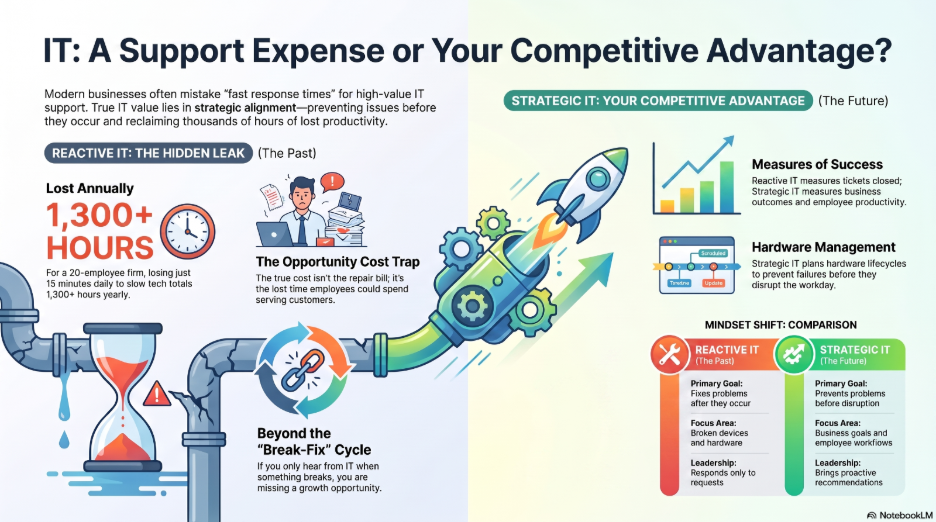
The Hidden Cost of Poor Technology
Most businesses know exactly how much they spend on technology each month. They know their managed IT agreement. They know their Microsoft 365 licensing costs. They know what they paid for for new laptops.
What many organizations never calculate is the cost of lost productivity.
Consider a company with 20 employees. If every employee loses 15 minutes each workday because of slow computers, recurring software problems, poor Wi-Fi, or delayed technical support, the company loses five hours of productive work every day.
Over the course of one year, that is more than 1,300 hours of lost productivity.
Those are hours employees could have spent serving customers, completing projects, generating revenue, or supporting coworkers.
The true cost of technology problems is rarely the repair bill. It is the cost of opportunities lost.
Reactive IT vs. Strategic IT
The difference between average IT support and strategic IT leadership becomes clear when you compare how each approaches technology.
|
Reactive IT |
Strategic IT |
|
Fixes problems after they occur |
Prevents recurring problems before they disrupt the business |
|
Measures success by tickets closed |
Measures success by business outcomes |
|
Focuses on broken devices |
Focuses on employee productivity |
|
Replaces aging hardware after failures |
Plans technology upgrades before failures occur |
|
Responds to requests |
Brings proactive recommendations to leadership |
|
Solves technical issues |
Solves business problems with technology |
The organizations that outperform their competitors have something more. Every business needs responsive technical support.
They have technology advisors who continually look for ways to improve the business.
Great IT Partners Eliminate Recurring Problems
Anyone can restart a computer and many can replace a failed hard drive. Those actions solve today's problem. Great IT partners focus on why those issues occurred in the first place.
For example:
Instead of repeatedly fixing Outlook, they investigate why Outlook continues to fail.
Instead of replacing failed computers at one time, they create a hardware lifecycle plan that reduces unexpected failures.
Instead of recovering ransomware, they build layered cybersecurity controls designed to prevent attacks from succeeding.
Eliminating recurring issues means employees spend less time waiting on technology and more time doing the work they were hired to do.
Questions Every Business Leader Should Ask Their IT Partner
Technology meetings should not revolve around support tickets. They should focus on business improvement. Ask your technology partner these questions during your next quarterly review.
How quickly do employees receive help when they need it?
Fast response times reduce downtime and keep projects moving.
What recurring issues should disappear this year?
If the same problems continue month after month, the underlying cause may never have been addressed.
What technology projects will improve productivity?
Technology investments should save employees time, simplify workflows, and remove unnecessary obstacles.
Are we getting the most from Microsoft 365?
Many organizations use only a fraction of collaboration, automation, and security features already included in their subscription.
Are our cybersecurity investments reducing business risk?
Cybersecurity should strengthen the business without making it harder for employees to do their jobs.
If this were your business, what technology improvements would you make first?
This question often produces the most valuable conversation. A strategic technology partner should already have recommendations.
Supporting Employees Is Just as Important as Supporting Technology
Technology exists to help people perform their jobs more effectively. Reliable systems reduce frustration.
Fast support minimizes interruptions. Well-designed cybersecurity protects employees without creating unnecessary obstacles. Thoughtful planning allows organizations to scale confidently as they grow.
When technology works the way, it should, employees spend less time fighting systems and more time serving customers.
That is where technology delivers its greatest return on investment.
Why Business Leaders Should Expect More from Their Technology Partner
Many organizations have accepted reactive IT as normal. It does not have to be all that you get from your IT provider. Technology should create measurable business values.
Your technology partner should help improve operations, reduce downtime, strengthen cybersecurity, support compliance, and prepare your organization for future growth.
If your conversations are limited to password resets and broken laptops, you are not receiving the full value your technology investment can deliver.
At 4BIS, we have believed since 1996 that supporting employees is just as important as supporting technology. That philosophy drives our approach to Managed IT Services, Cybersecurity Services, and long-term technology planning.
If you are evaluating how technology supports your organization's growth, you may also find this resource helpful: Business Maturity and Cybersecurity Growth
Frequently Asked Questions
What is strategic IT support?
Strategic IT support goes beyond fixing technology issues. It aligns technology with business goals, improves employee productivity, reduces risk, and helps organizations plan for future growth.
How does IT improve employee productivity?
Reliable technology minimizes downtime, automates repetitive tasks, improves collaboration, and gives employees the tools they need to work efficiently.
What is the difference between reactive and proactive IT support?
Reactive IT responds after problems occur. Proactive or strategic IT identifies risks, prevents recurring issues, and recommends improvements before disruptions happen.
How often should a business review its technology strategy?
Most organizations (like 4BIS) benefit from reviewing their technology roadmap at least quarterly. Regular reviews help ensure technology investments continue supporting changing business objectives.
Final Thoughts
Your technology should help employees accomplish more every day. It should reduce downtime, improve efficiency, strengthen security, and support the growth of your business.
If your current IT partner spends more time reacting to problems than helping your organization improve, it may be time for a fresh perspective.
For three decades, 4BIS has helped businesses throughout Greater Cincinnati align technology with business strategy. Whether you need fully managed IT services, co-managed IT support, cybersecurity guidance, or simply a second opinion on your current environment, our team is here to help.
Call to schedule a conversation. Let's discuss how your technology can become a competitive advantage instead of just another business expense.