Manufacturers depend on technology at nearly every stage of production from quoting and scheduling to inventory, quality control, shipping, and customer communication. When that technology slows down or becomes unavailable, the effects can reach far beyond the office. Production can stall, deadlines can slip, and security incidents can disrupt both operations and supply-chain relationships.
That makes choosing a provider for managed IT and cybersecurity services an operational decision, not just a technical one.
The right partner should understand the demands of a manufacturing environment. They should support both day-to-day performance and long-term planning and provide security that extends beyond basic antivirus software. For Cincinnati manufacturers evaluating providers in 2026, these seven factors offer a practical way to compare options.
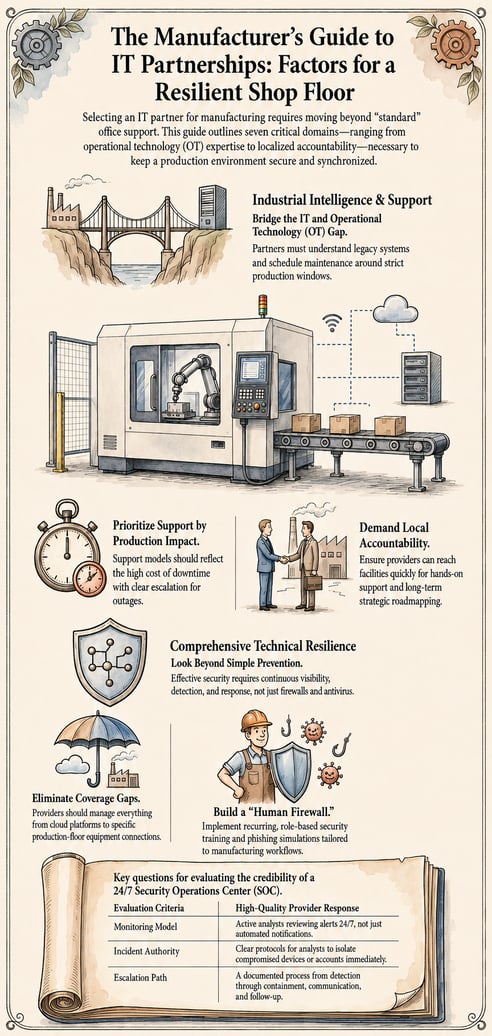
Seven Factors to Consider
1. Coverage Across the Entire Technology Environment
Start by defining what the provider will manage. A manufacturing business may rely on office computers, mobile devices, servers, cloud applications, wireless networks, production-floor systems, and connections between multiple facilities. If responsibilities are divided among several vendors, gaps can emerge quickly.
A qualified provider should be able to explain which parts of the environment are included, which are excluded, and how it coordinates with equipment vendors or internal staff. Ask whether its services cover:
End-user devices and help desk support
- Servers, networks, firewalls, and wireless systems
-
Microsoft 365 or other cloud platforms
-
Backup and disaster recovery
Identity and access management
Vendor coordination, compliance and technology planning
Multiple facilities and remote employees
For organizations adopting cloud-managed IT services, visibility is especially important. Centralized monitoring and management can make it easier to support multiple locations, standardize configurations, deploy updates, and identify problems before they interrupt production. The provider should still be clear about where cloud management ends and hands-on, on-site support begins.
2. Manufacturing and Operational Technology Experience
General business IT experience is useful, but manufacturing introduces additional requirements. Production environments often contain legacy systems, specialized equipment, industrial control technology, and applications that cannot be patched or restarted on a typical office schedule.
Ask prospective providers about their experience supporting manufacturers of a similar size and complexity. They should understand how information technology and operational technology interact, even if a machine builder or controls integrator remains responsible for the equipment itself.
Look for a provider that can discuss practical issues such as:
- Separating production networks from business networks
- Managing remote vendor access to equipment
- Supporting legacy systems that cannot be easily replaced
- Scheduling maintenance around production windows
- Documenting critical systems and dependencies
- Reducing single points of failure
The goal is not to find a provider that claims ownership of every machine on the floor. The goal is to find a partner who understands the operational impact of IT decisions and collaborates effectively with plant personnel and specialized vendors.
3. Security Depth Beyond Basic Prevention
Firewalls, antivirus, and software updates remain important, but prevention alone is not a complete security strategy. Threats can bypass preventive controls through stolen credentials, social engineering, unpatched software, or trusted third parties.
Strong managed security services should combine prevention with continuous visibility, detection, response, and recovery. When comparing providers, ask how their security program addresses:
- Endpoint detection and response
- Email and identity protection
- Multifactor authentication
- Vulnerability management and patching
- Security configuration standards
- Backup protection and recovery testing
- Incident response planning
- Reporting and risk reviews
It is important to understand whether security is included in the standard service or sold as an optional add-on. A low base price can be misleading if essential protections require separate contracts.
Ask the provider to explain its security stack in plain language. You need what each tool does, who monitors it, what happens when an alert appears, and how the team will communicate with you during an incident.
4. A Credible Monitoring and Response Model
Cybersecurity alerts do not follow business hours. A provider that advertises 24/7 SOC monitoring should be able to describe exactly what that means. Is a security operations center actively reviewing alerts around the clock, or are automated systems simply generating notifications for someone to review later?
This distinction matters. Effective managed detection and response combines skilled analysts who investigate suspicious activity, separate genuine threats from false positives, and take appropriate action when needed.
Ask prospective providers:
- Who monitors alerts after hours?
- Is the security operations center internal or provided by a third party?
- What events trigger immediate investigation?
- Can analysts isolate a compromised device or account?
- Does the provider need approval before taking containment action?
- How quickly will your team be notified?
- Is incident response included, limited, or billed separately?
Request a sample escalation process or incident report. Expert providers should be able to show how an alert moves from detection through investigation, containment, communication, and follow-up.
5. A Support Model Built Around Production Priorities
Fast support is valuable, but a meaningful support commitment needs more detail than we respond quickly. Manufacturers should examine how the provider prioritizes issues and whether its escalation process reflects the cost of production downtime.
Ask how the help desk handles a single-user problem compared to a company-wide outage, an unavailable ERP system, or a failed connection to a critical production application. Review the provider’s service-level agreement carefully, including:
- Support hours and after-hours coverage
- Response targets by severity
- Escalation paths
- On-site support availability
- Average resolution performance
- Communication during major incidents
- Limits on included support
For small and midsize business IT support, consistency is often as important as speed. Find out whether your employees will reach a stable team that knows your environment or a general queue with frequent handoffs. Named technical contacts, accurate documentation, and clear ownership can shorten resolution times and reduce repeated explanations.
6. Employee-Focused Security and Practical Training
Employees are part of the security system. They handle email, passwords, files, vendor requests, and financial transactions every day. Even strong technical controls can be undermined when employees are unprepared to recognize phishing, impersonation, or other social-engineering tactics.
Effective security awareness training should be ongoing, relevant, and measurable. Annual training alone may satisfy a checkbox, but it does little to reinforce secure behavior throughout the year.
Look for a program that includes:
- Short, recurring training modules
- Phishing simulations
- Role-based content for higher-risk teams
- Clear reporting procedures
- Coaching employees who need additional help
- Progress and risk reporting for leadership
Training should also reflect real manufacturing workflows. Employees in accounting, purchasing, human resources, engineering, and plant operations may face different threats. A good provider will help tailor the program without turning it into a punitive exercise. The objective is to make reporting suspicious activity easy and to build habits that reduce risk.
7. Local Accountability and Long-Term Fit
Technology can be managed remotely, but local knowledge still matters. Greater Cincinnati manufacturers should consider whether a provider can reach their facilities when remote support is not enough. Additionally, it’s beneficial to understand the region’s labor market, infrastructure, and business community.
Local fit is not only about distance. It also includes communication style, responsiveness, and the provider’s ability to grow with the business. Ask how often strategic reviews occur, and how recommendations are prioritized.
A strong long-term partner should provide more than support tickets. It should help develop a technology roadmap, forecast upcoming investments, track risk, and connect technology decisions to business goals. It should also be transparent about contract terms, price increases, project fees, and the process of leaving the relationship.
Before signing, request references from comparable clients. Ask for those references about responsiveness during outages, quality of planning, consistency of personnel, and whether the provider follows through on commitments.
Questions to Ask During the Evaluation
Use the same questions with every provider so you can make a fair comparison:
- Which systems, users, locations, and security services are included in the quoted price?
- What manufacturing environments have you supported?
- How do you protect and monitor both cloud and on-premises systems?
- Who reviews security alerts overnight, on weekends, and on holidays?
- What actions can your team take during a suspected compromise?
- How do you prioritize production-impacting incidents?
- When is on-site support available in the Cincinnati area?
- How often do you test backups and recovery procedures?
- What security training and reporting are included?
- How will you help us plan budgets, upgrades, and risk reduction over the next 12 to 36 months?
Choose a Partner That Supports Resilience
The best provider is not necessarily the one with the longest tool list or the lowest monthly price. It is the provider that can clearly define its responsibilities, demonstrate security depth, respond effectively when something goes wrong, and align its service with the realities of manufacturing.
As you compare managed IT and cybersecurity services in 2026 (and into 2027) look beyond product names and broad promises. Evaluate how each provider will protect uptime, support employees, reduce cyber risk, and help leadership make better technology decisions. A disciplined review now can lead to a more resilient, predictable, and secure operation in the years ahead.